
I’ll be straight with you, the first time someone asked me if I could run on a treadmill, I almost laughed.
Rucking felt like an outdoor thing. Boots on dirt, pack on back, open road ahead. Then I tried it indoors. 30 pounds, 10% incline, 3 mph.
20 minutes later, I was humbled, sweating, and completely sold. So, can you ruck on a treadmill?
Yes, absolutely. Rucking on a treadmill is not just possible, it’s one of the most efficient, low-impact, full-body workouts available to you while indoors. Crank your incline between 5–15% and throw some weight in a pack (20–40 lbs)..

Walk at 2.5–3.5 mph. No running needed. The power lies in the weight and elevation
In this article, I will talk about beginner’s tips, common mistakes, and progression plans, as well as the treadmill rucking debate. Let’s get into it-
Key Takeaways:
- Rucking on a treadmill is a safe, effective, and beginner-friendly workout.
- Begin with 10-15% of your body weight, and gradually increase over the next 4–6 weeks.
- Treadmill Rucking allows for precise control over intensity, working great for increasing cardiovascular endurance.
In This Post……
- Is Rucking on a Treadmill Good?
- Can You Ruck on a Treadmill for Beginners?
- Should You Run With a Ruck on a Treadmill?
- Can You Run on a Walking Treadmill While Rucking?
- Can I Use a Treadmill If I’m Over the Weight Capacity?
- Ruck on a Treadmill: The Full Workout
- Rucking Mistakes to Avoid on a Treadmill
- Rucking Mistakes to Avoid on a Treadmill
- Who Should Ruck on a Treadmill?
- Frequently Asked Questions:(FAQs)
- Final Thoughts
Is Rucking on a Treadmill Good?
Yes – rucking on a treadmill is genuinely good, and in some ways better than outdoor rucking for specific goals.
Here’s what surprised me most-
The treadmill removes all the unpredictability of outdoor terrain and lets you control every single variable. Incline, speed, duration, load all of it is measurable and repeatable. That makes progressive overload not just possible, but precise.
According to the Journal of Strength and Conditioning Research,
Adding external load to walking increases oxygen consumption, caloric expenditure, and muscular recruitment, especially in the glutes, hamstrings, calves, and spinal erectors.

You’re doing cardio and resistance training at the same time. That’s the rucking sweet spot.
From a joint health standpoint, rucking on a treadmill is far kinder to your knees than running.
Studies show running places roughly 8 times your body weight on your knees. Loaded walking sits around 2.7 times. That’s a significant difference – especially if you’re coming back from injury or just want a sustainable long-term routine.
Can You Ruck on a Treadmill for Beginners?
Yes, and honestly, the treadmill is the ideal starting point for beginners.
Outdoor rucking introduces too many variables at once:
uneven terrain, unpredictable hills, and weather.
On a treadmill, you control everything. You can start conservative, feel how your body responds to load, and build from there without worrying about getting stranded a mile from home with shredded shoulders.
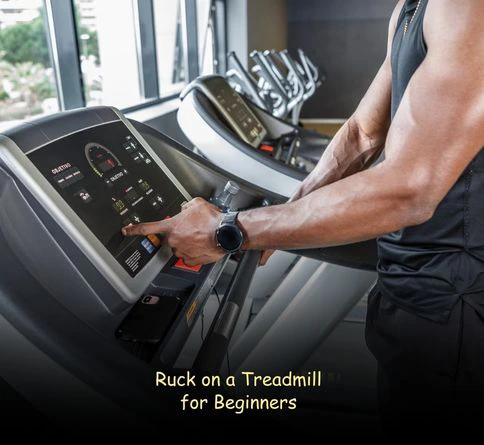
Here’s what I recommend for beginners:
Week 1–2 Starting Point:
- Weight: 10% of your body weight
- Incline: 5–8%
- Speed: 2.5–3 mph
- Duration: 20–30 minutes
That’s it. Don’t overthink it. The goal in week one isn’t intensity it’s learning how the weight feels on your back, how your posture holds up, and where your weaknesses are. Most beginners discover their core gives out before their legs do. That’s useful information.
One thing I always tell beginners: resist the urge to hold the handrails. I know it feels steadier. But the moment you grip those rails, you offload the effort from your core and stabilizers — which is exactly where rucking builds its real value. Use the rails only if you genuinely need balance support.
Should You Run With a Ruck on a Treadmill?
Yes, walking or running, a ruck (weighted backpack) on a treadmill for that exact purpose, to build cardiovascular endurance and strength while burning more calories in that controlled, low-impact environment? Here’s what you need to know:
- Safe Alternative: Great potential replacement and allows you to change incline and speed with precision while still giving an outdoor feel (when the weather is bad or dangerous)
- Incline Over Speed: Zero in on a high incline (5–12%) instead of high speed, this ensures maximum muscle engagement while keeping knee strain low.
- Compact Gym Matters: Always keep your right posture, maintain a moderate pace, and hook up to the health stop for care.
- One downside: the experience can be monotonous, and it won’t fully capture the uneven, kinetic experience of rucking outside but as a starting point, or for inclement weather backup, hard to beat
Can You Run on a Walking Treadmill While Rucking?
- Walking treadmills, the under-desk style or low-speed models, are generally not built for rucking. Most cap out at 3–4 mph and aren’t designed for incline work or the added stress of a weighted pack.
- If you’re asking whether you can run on a walking treadmill without a pack, the answer is no they’re not built for running speeds or the impact that comes with it.
- For rucking specifically, you want a standard treadmill with at least 12–15% incline capability and a solid motor. That incline range is where most of the training benefit lives.
Can I Use a Treadmill If I’m Over the Weight Capacity?
This is an important safety question, and it deserves a direct answer.
Every treadmill has a maximum user weight rating typically between 220 and 350 lbs for home models, and up to 400 lbs for commercial gym machines. If you’re rucking, you need to add your pack weight to your body weight when evaluating this limit.
For example, if you weigh 200 lbs and you’re carrying a 40 lb ruck, you’re putting 240 lbs of load on the belt and frame. Make sure that’s within the machine’s rated capacity.
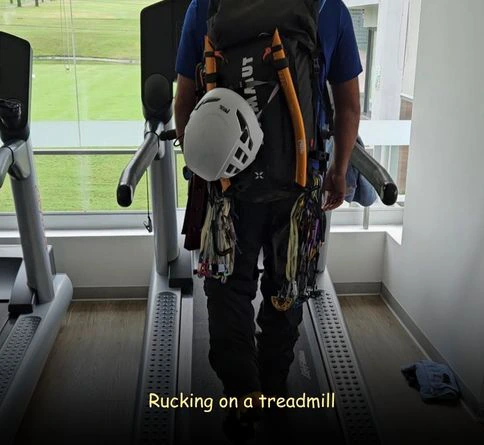
Exceeding the weight limit risks belt slippage, motor burnout, and most critically, treadmill failure mid-session, which is a genuine injury hazard. Always check the spec plate on your machine before loading up.
Ruck on a Treadmill: The Full Workout
Here’s a complete beginner-to-intermediate treadmill rucking session you can run today.
What You’ll Need:
- A rucksack or tactical backpack (GoRuck GR1 is excellent, but any sturdy hiking pack works)
- Ruck plates or weight plates: 20–40 lbs, depending on your level
- Trail runners or low-cut boots not standard running shoes
- A treadmill with 12–15% incline capability
The Workout (45–60 Minutes Total)
Step1: Warm-Up
- 5 Minutes Speed: 2.0 mph
- Incline: 0%
- No pack walks easily.
- Roll your shoulders, loosen your hips, mobilize your ankles.
- Don’t skip this a cold back under load is asking for trouble.
Step 2: Block 1 — Ramp Up (10 Minutes) Speed:
2.5 mph | Incline: 5% | Pack on Get comfortable.
Settle in and pay attention to posture back neutral, core lightly engaged, chin up. Let the weight sit naturally on your hips, not just your shoulders. Cinch that hip belt.
Block 2 — Main Effort (20 Minutes) Speed:
3.0 mph | Incline: 10–12% | Pack on This is the meat of the session.
Your glutes should be clearly working by minute five. Aim for Zone 2–3 heart rate — roughly 60–75% of your max. Breathe steadily. Don’t drift into a hunch.
Block 3 — Final Push (10 Minutes) Speed:
2.8 mph | Incline: 15% | Pack on Drop speed slightly, max out the incline.
This targets the posterior chain hard and spikes your caloric burn. It’s supposed to be uncomfortable. That’s the point.
Cool-Down — 5–10 Minutes Speed:
2.0 mph | Incline: 0% | Pack off Remove the pack and walk it out.
Let your heart rate come down naturally. Do some light hip flexor and shoulder stretching afterward.
Rucking Mistakes to Avoid on a Treadmill
Holding the handrails. I said it before, and I’ll say it again. Let go. Your stabilizers need to work. That’s the workout.
Too much weight too fast. Start at 20 lbs. I don’t care how fit you are. The load distribution on a ruck is completely different from that of a barbell or dumbbell. Give your connective tissue time to adapt.
Skipping the incline. Flat treadmill rucking is a fraction of the effectiveness. The incline drives posterior chain activation, caloric burn, and cardiovascular demand. Never skip it. Wrong footwear. Running shoes don’t have the heel structure or ankle support for loaded hiking.
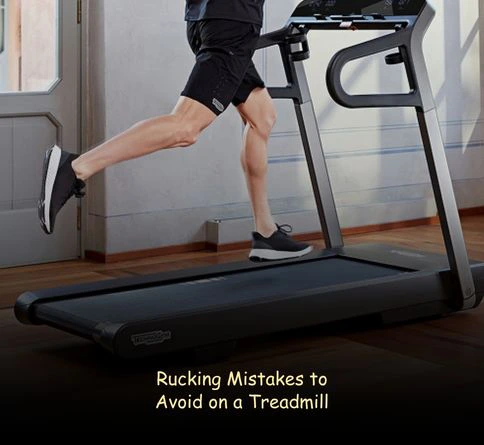
Use trail runners or low-cut boots. Your ankles will thank you.
Loose pack fit. A bouncing, shifting pack creates shear forces on your spine with every step. Tighten the hip belt so it sits on your iliac crest, snug the shoulder straps, and keep the weight close to your body and high on your back.
Quick Summary:
- Never hold the handrails — your core stability is the workout.
- Start at 20 lbs regardless of fitness level and progress slowly.
- Always use incline, wear proper footwear, and fit your pack tightly before every session.
Rucking Mistakes to Avoid on a Treadmill
- Holding the handrails. I said it before, and I’ll say it again. Let go. Your stabilizers need to work. That’s the workout.
- Too much weight too fast. Start at 20 lbs. I don’t care how fit you are. The load distribution on a ruck is completely different from a barbell or dumbbell. Give your connective tissue time to adapt.
- Skipping the incline. Flat treadmill rucking is a fraction of the effectiveness. The incline drives posterior chain activation, caloric burn, and cardiovascular demand. Never skip it.
- Wrong footwear. Running shoes don’t have the heel structure or ankle support for loaded hiking. Use trail runners or low-cut boots. Your ankles will thank you.
- Loose pack fit. A bouncing, shifting pack creates shear forces on your spine with every step. Tighten the hip belt so it sits on your iliac crest, snug the shoulder straps, and keep the weight close to your body and high on your back.
Who Should Ruck on a Treadmill?
Treadmill rucking isn’t just for military veterans or extreme fitness junkies. It’s one of the most accessible high-output workouts available, and I’ve trained alongside people ranging from 22 to 64 years old doing it effectively.
It’s ideal for:
- Runners dealing with knee or hip issues who need low-impact cardio
- Gym-goers stuck in a plateau who need a new training stimulus
- Anyone training for GORUCK events, Spartan races, or military fitness tests
- Older adults seeking a strength-cardio combination without joint punishment
- Beginners who want real results without the complexity of a full gym program
The consistent feedback I hear is always the same: rucking on a treadmill delivers a kind of full-body exhaustion you simply don’t get from an elliptical or a standard walk. It’s honest work — and the results are honest too.
Quick Summary:
- Treadmill rucking works for all fitness levels — from beginners to advanced athletes.
- It’s especially valuable for people with knee issues, plateau breakers, and anyone training for endurance events.
- If you’re bored with standard cardio and want real full-body results, this is your answer.
Frequently Asked Questions:(FAQs)
Can you run on a treadmill for beginners?
Yes — the treadmill is actually ideal for beginners. It gives you full control over load, incline, and speed. Start at 15–20 lbs, 5–8% incline, and 2.5 mph for 20–30 minutes.
Should you run with a ruck?
Generally, no — especially not at first. Running with a loaded pack increases spinal compression significantly. Stick to an inclined walk. It’s harder than it sounds.
Is rucking on a treadmill good for weight loss?
Yes. A 45-minute session with a moderate load burns 400–600 calories while simultaneously building lean muscle. That combination makes it highly efficient for fat loss over time.
Can I use a treadmill if I’m over the weight capacity?
Add your body weight and pack weight together before checking the machine’s rated capacity. Never exceed the manufacturer’s limit — it’s a safety risk, not just a machine risk.
What incline should I run at on a treadmill?
Minimum 5%, sweet spot 10–12%, maximum effort at 15%. Skipping the incline dramatically reduces the effectiveness of treadmill rucking.
How often should I run on a treadmill?
2–3 sessions per week. Allow at least 48 hours between sessions — rucking is demanding on the posterior chain and connective tissue, and recovery is part of the program.
Final Thoughts
Can you run on a treadmill? Without question — yes. And if you’ve been sleeping on it, now’s the time to stop.
Treadmill rucking takes a battle-tested military training method and makes it accessible, measurable, and repeatable for anyone with a pack and a gym membership. It builds real muscle, burns serious calories, protects your joints, and delivers a kind of full-body challenge that most cardio machines simply can’t replicate.
Strap on the pack. Set the incline. Earn it.

Leave a Reply