
I used to think running was the gold standard of fitness. If you wanted to lose weight, build endurance, or “get in shape,” you ran. Simple.
But then I started rucking, and I realized something surprising. It felt challenging like running, but without the constant pressure on my knees.
So, a question arises: Is rucking better than running?
Yes, rucking is better than running for building muscle, protecting joint health, sustainable weight loss, and long-term overall fitness. Running is excellent for quick calorie burn and strong cardiovascular conditioning, but rucking offers more full-body engagement, training variety, and lower joint stress.

In this article, I will talk about- is rucking better for you than running? Below, I will discuss several areas of rucking and running to get the real answer. Let’s see-
- Running is good for immediate calorie burn and provides strong cardiovascular benefits.
- Rucking engages the upper body, core, and legs. While running targets the lower body.
- Rucking provides low impact on the knee. It forces around 2.7 times body weight on the knee while running provides 8 times body weight.
- Combining both helps achieve a balanced, more fitted look.
In This Post……
- Is Rucking Better Than Running
- Training Variety: Rucking Vs. Running
- Rucking is More Social than Running
- Rucking Is Better For Building Muscle than Running
- Is Rucking Better Than Running For Weight Loss?
- Is Rucking Better For Your Knees Than Running?
- Rucking Offers More Versatility than Running
- Frequently Asked Questions (FAQs)
- Final Words
Is Rucking Better Than Running
Yes, rucking is better than running for building muscle, protecting joint health, weight loss, cardiovascular endurance, and overall health. It provides greater versatility and variety in training and is easier on the knee than running.
According to Force Fitness,
Rucking is closer to running. It trains the heart, lungs, muscles, bones, and connective tissues simultaneously. The extra weight increases the heart rate even at slower speeds. It means you are getting a strong cardio workout without the constant pounding of running.
Running mainly works your heart and lungs. It boosts aerobic fitness and strengthens leg endurance, but it does little for upper-body strength, grip, bone strength, or the ability to handle heavy loads.
So, for long-term sustainability, ruck marching is better than running to build muscle and engage the full body. But can we combine both?
Definitely, you can add some running sections to your rucking. This military origin training will make you fitter, improve your walking pace, and increase your endurance.
But, is rucking as good as running for overall fitness? It depends on your physical condition, personal preference, and goals. Do the workout you enjoy, and that makes you happy.
Training Variety: Rucking Vs. Running
Rucking offers more variety in training than running.
In running, you can change two variables in training. These are speed and duration. You can increase or decrease these while running. However, most runners find themselves stuck in the same routine; running a specific distance at a set pace with very limited variation.
Rucking provides a third variable in your training:weight. The extra weight allows a variety of training facilities.
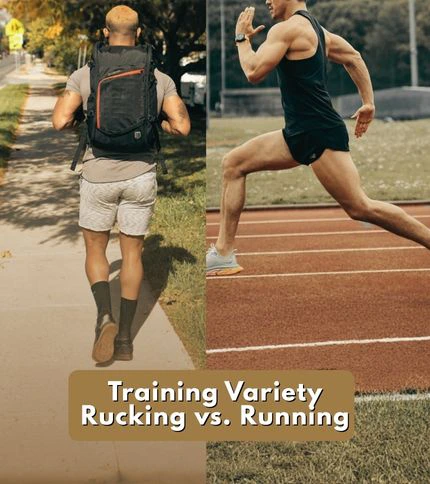
Over time, you can increase your weight by more than 25-30% for short or long distances. You can choose a path based on your goal, but running should be on a flat surface to reduce the risk of injury.
Rucking is More Social than Running
Rucking is more social than running.
In running, we can run with other friends or people. But can every runner be your running partner?
The answer is no. You have to choose a friend or a person who can run at your exact pace for the desired distance. Either you or your partner has to run at a sub-optimal pace to make it social, which is a little difficult to maintain.
When rucking, suppose you are at a faster or slower pace than your partner, you can equalize by adjusting the weight. A light weight will help you to walk fast and vice-versa.

According to Rucking.com,
An avid runner who finishes a mile in 14 minutes can join with a beginner who moves at an 18-minute pace. The avid person can easily add some weight and reduce the pace. Therefore, they can both exercise together and still get a good challenge.
Rucking Is Better For Building Muscle than Running
When it comes to building muscle, rucking has more advantages than running. It helps build muscle and improve the overall strength of your body.
Rucking means walking with a weighted vest that forces your body to work against added resistance. The extra load activates your glutes, quads, hamstrings, core, claves, shoulder, and back. It also helps strengthen and make your foot more durable.
According to Rucking.com, the extra weight and the ability to go heavy with a rucksack lead to greater muscle development than running.
On the other hand, running is mainly a powerful cardiovascular exercise for developing strong legs and feet. Running with a rucksack helps more with muscle building than general training. But most runners neglect it in favor of additional training.
As a rucker, you wouldn’t need any additional leg and core exercises for muscle building. Just wear a rucksack, and feel all the muscles engaged even when you are standing.
Quick Summary:
- Rucking is generally better for muscle growth and full-body strength.
- If your focus is speed, endurance, and cardiovascular fitness, running is the stronger option.
Is Rucking Better Than Running For Weight Loss?
Rucking, which means walking with a weighted backpack, is better than running for sustainable weight loss. Running burns more calories per minute but can lead to injury. Rucking is a beginner-friendly workout that helps you build muscle with less stress on your joints, including your knees.
Research Physiologist David Looney says, running burns more calories than rucking. He also says that many calorie-calculation models fail to capture the true energy cost of rucking accurately and often underestimate it. So, while running wins for short-term calorie burn, total weight loss depends on factors such as load, duration, terrain, etc.
In running, calorie burn increases with speed and duration. Though running burns more calories, it is not sustainable for long. Running is a high-impact exercise, which is why most people can’t run for long.

On the other hand, ruck marching is a low-impact workout. A longer ruck helps build your strength and endurance, and can burn more calories than a short run.
Runners often deal with injury, while more time with a weighted vest can keep your body healthy and fully engaged. So, if you are injury-free, you can exercise more consistently. That consistency helps burn calories, lose weight, and build a healthy lifestyle over time.
Quick Brief:
- If your body is ready to run and you want to burn calories quickly, go for a run.
- If you want a sustainable and low-impact workout, go for rucking.
Is Rucking Better For Your Knees Than Running?
Yes, rucking is easier for your knees.
A study found that running provides 8 times more body weight on the knee. That means that if you are 160 lbs, you will experience a force of about 1280 pounds on your knee.
Conversely, walking provides only 2.7 times more body weight on the knee. For example, your weight is 150 pounds, and you are carrying a backpack weighing 40 pounds. So, you will get a force of 513 lbs on the knee.

This reduction of forces will reduce the impact on the knee. It will help strengthen it over time, compared to running, and reduce the risk of injury.
Rucking Offers More Versatility than Running
You can run anywhere, from hills to city streets,, such as our favorite outdoor spots with friends, parks, treadmills, stairs, etc.
Running is almost the same. You can run as far as your shoes will take you.
A rucker can pack the essential food, water bottle, and gear for weather changes in the rucksack. It provides more versatility in fitness.
For example, using a stair climber machine can make your legs stronger and improve your heart health, but you can’t safely move fast on it like you do when running.
Running can help if you’re in a hurry, like trying to catch a flight. But rucking is helpful anytime you carry weight.
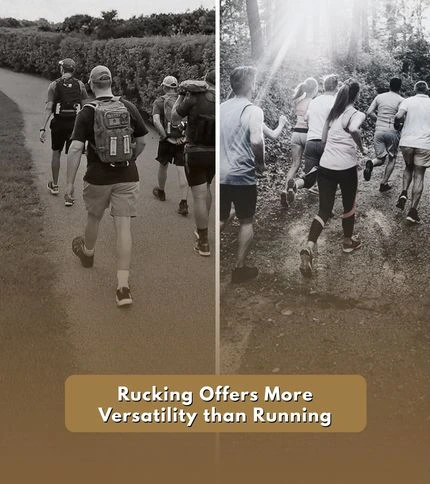
When you carry school books, a laptop for work, or camping equipment, you are basically rucking. It trains your body for everyday tasks and makes carrying things feel easier and more purposeful.
Frequently Asked Questions (FAQs)
Is rucking more effective than running?
Yes, rucking is more effective than running for full-body strength, joint protection, and long-term sustainability. While running burns more calories per minute and strongly improves cardiovascular fitness, running engages the upper body, core, and legs while placing significantly less stress on the knees.
Can I replace running with rucking?
Rucking can replace running in some cases, but it works best as a complement rather than a full replacement. I will suggest crossing trains 1–2 times per week.
What pace should you ruck at?
Maintain a pace between 15 and 20 minutes per mile while rucking. This range keeps your heart rate elevated, builds endurance, and allows you to maintain proper posture under load.
Does Rucking Help Running?
Yes, rucking helps running by strengthening your glutes, hamstrings, calves, and core. These muscles improve running posture, endurance, and injury resistance.
Final Words
Are you still wondering- Is rucking better than running? From the above analysis, rucking is better. However, both workouts provide overall health benefits, such as increased muscular power, increased calorie burn, and improved heart rate. But rucking also provides more versatility, social benefits, and variety in training. I suggest combining both to engage the body for good health fully.

Leave a Reply