
At the beginning of my rucking, a common question arose in my mind: Does rucking burn more calories than walking, hiking, jogging or running? Let me share something first.
I used to walk every evening after dinner. Same route, same pace, same supportive shoes. It felt good, but it didn’t feel challenging. One day, I added a 20-pound backpack to “test” it. Within ten minutes, I noticed the difference. My breathing got deeper. My shoulders tightened to hold the weight steady. My heart was clearly working harder.
That’s when I understood rucking is not just walking. So, does rucking burn more calories?
Yes. Rucking burns more calories than regular walking and hiking because you’re carrying extra weight. That load carriage forces your core, back, shoulders, and legs to work harder. Your heart rate increases, your oxygen demand rises, and your body uses more energy to move the same distance.

Though jogging and running burn more calories. But rucking is a sustainable and low-impact way to increase fat burn without running.
In this article, I will talk about how many calories rucking burns than walking, hiking, jogging, and running, and the science behind burning more calories. Let’s see in detail-
In This Post……
- Does Rucking Burn More Calories
- Does Rucking Burn More Calories Than Walking?
- Does Rucking Burn More Calories Than Running?
- Does Rucking Burn More Calories Than Hiking?
- Does Rucking Burn More Calories Than Jogging?
- The Science of Burning More Calories (Rucking)
- Frequently Asked Questions (FAQs)
- Final Thoughts
Does Rucking Burn More Calories
Yes, rucking burns 1.5 to 3 times as many calories as walking. It can also approach the calorie burn of running depending on the load, pace, terrain, and body weight.
During rucking, we need to carry an extra loaded backpack. But it is not bad for your back. Generally, it needs more energy to carry this loaded rucksack. This extra resistance forces your muscles, especially your glutes, hamstrings, and upper body, to work harder.
According to the American Council on Exercise (ACE), rucking with a weighted vest significantly increases oxygen consumption and calorie expenditure compared to normal walking.
The US Army Standard (USARIEM) says that calorie burn rises in proportion to added weight, pace, and terrain factor.
Does Rucking Burn More Calories Than Walking?
Yes, rucking burns more calories than walking. It burns 1.5 to 2 times more calories than walking, and under heavier load or uphill terrain, it can approach 2-3 times the calorie expenditure.
While both the traditional walking and rucking offers cardiovascular benefits, ruck marching makes the excercise top notch.
Many general and army researchers found that rucking burns 400-700 calories per hour. In contrast, traditional walking can burn 200-400 calories per hour.

Let’s see a comparison from BodySpec, an individual of 180 lbs, and moving for 1 hour–
| Activity | Intensity | Estimate Calorie Burn | Impact Level |
|---|---|---|---|
| Traditional walking | 3.5 mile per hour | Around 300 calories | Low |
| Rucking with 30 lb pack | 3.5 mile per hour | Around 500 calories | Moderate |
| Rucking with 50 lb pack | 3.5 mile per hour | Around 650 calories | Moderate |
Quick Summary:
- On flat ground, rucking burns 1.5 to 2 times more calories than walking.
- It can expend2-3 times more energy insteeper terrain or with a heavier load
Does Rucking Burn More Calories Than Running?
No, in most cases running burns more calories per minute than rucking. But rucking can approach running-level calorie burn, depending on backpack weight, pace, duration, and terrain.
Running is a higher-impact cardiovascular exercise that significantly increases oxygen consumption (VO₂) and overall energy expenditure per minute. At longer distances, it can break down muscle growth (Catabolic).
Rucking is a resistance workout that adds an external load, increasing muscular power and total work performed over time. It is a sustainable exercise that engages the whole body. Total calorie burn is almost as high as running.

But the important thing is that not everyone can run, and they could get injured. Here actually wins the ruck for sustainability.
Let’s see a comparison I got the last time from my friend, he is 180 lbs and moving for 1 hour-
| Activity | Intensity | Estimate Calorie Burn | Impact Level |
| Running | 6.0 miles per hour (10 mins/mile) | Around 800 | High |
| Rucking with 50 lb pack | 3.5 mile per hour | Around 650 calories | Moderate |
Summary:
- Running wins for calorie burn per minute.
- Rucking wins for sustainability.
Does Rucking Burn More Calories Than Hiking?
Yes, rucking burns more calories than normal hiking. Rucking burns 15-45% more calories compared to unloaded hiking.
Hiking is normally walking for extended periods in natural environments such as forests, hills, mountains, deserts, and countryside trails. The American Hiking Society defines hiking as recreational walking in natural environments for fitness, adventure, or enjoyment. In most cases, it is unloaded walking. It burns calories due to uneven terrain and elevation changes.
On the other hand,rucking is a military origins workout which involves walking with a weighted backpack.
According to the Compendium of Physical Activities,
- Moderate hiking = ~6.0 METs
- Walking with a 30–50 lb pack = 7.0–9.0 METs

Quick takeaway:
- Rucking burns more calories than unloaded hiking.
- If hiking includes a heavy pack, the calorie burn becomes comparable.
Does Rucking Burn More Calories Than Jogging?
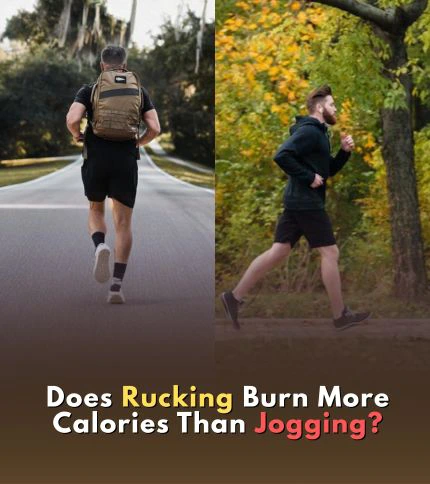
No. Jogging burns more calories than rucking. But rucking can burn jogging-level calories depending on your backpack weight, pace, terrain and duration.
According to the Harvard Medical School,
A person of 180 lbs at 5-6 miles per hour can burn around 700–800 calories. Jogging is associated with higher energy expenditure due to its high impact and elevated oxygen consumption (VO₂).
According to the Compendium of Physical Activities,
Jogging burns almost 7.0–8.3 METs depending on speed. In contrast,rucking burns around 6.0–9.0 METs depending on the weight, pace and terrain. That means heavy rucking on incline terrain can reach similar intensity levels. But, typical steady jogging still burns slightly more calories per minute.
The Science of Burning More Calories (Rucking)
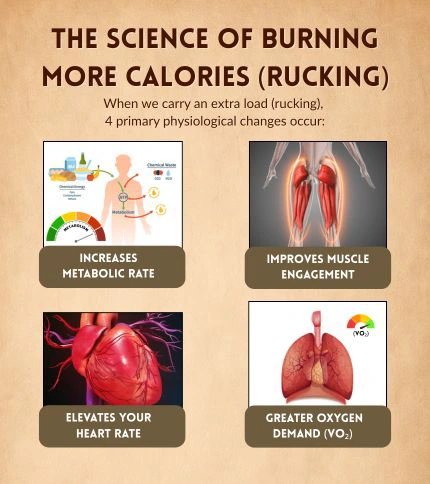
When we carry an extra load, 4 things commonly occur. These are-
- It increases the Metabolic Rate
- Improve the Muscle Engagement
- Elevate your Heart Rate
- Greater Oxygen Demand (VO₂)
Let’s break down-
1. Increase Metabolic Demand
When you add a weighted backpack, your body needs more energy to carry. Therefore, the muscle groups must work harder to maintain stability, which costs more calories than normal walking. But it is important to know how much weight should you carry for rucking because extra load can lead to back pain.
2. Improve Muscle Engagement
Rucking engages more muscles than regular walking. During rucking, the upper body becomes more active to maintain stability. Which means your core, back, and shoulders become more active. At the same time, your legs move you forward just like in normal walking. As more muscles are involved and work harder, they burn more calories and fat loss.
3. Elevated Heart Rate
When we carry extra weight, our heart rate usually increases faster than when we walk at the same speed without a load. Therefore, the heart rate goes up, our body works harder, uses more energy, and weight loss occurs. As a result, it burns more calories.
4. Greater Oxygen Demand (VO₂)
During rucking, your body needs more oxygen, even at the same normal speed. This increases your METs (Metabolic Equivalent of Task), which is a standard way to measure how much energy an activity uses.
Regular walking is usually around 3–4 METs. But walking with about 10% of your body weight can raise it to roughly 6–8 METs, depending on pace and terrain. The higher the MET level, the more energy your body uses. As a result, calorie burn increases.
However, compared to normal walking, hiking burns more calories. For jogging and running, rucking is comparable in terms of pace, load, and distance. Rucking is a sustainable exercise to achieve your fitness goals without any risk.
Frequently Asked Questions (FAQs)
Does Rucking Burn More Calories on Hills?
Yes. Rucking burns more calories on hills than flat terrain. Uphill walking increases muscle effort, heart rate, and oxygen demand.
Does Rucking Burn Belly Fat Faster?
Rucking helps burn overall body fat by increasing calorie expenditure. Belly fat reduces over time when rucking is combined with a calorie-controlled diet.
How Many Calories Does Rucking Burn Per Hour?
Generally, rucking burns 400–700 calories per hour, depending on body weight, load carried, pace, and terrain.
Is Rucking Better Than Running for Calorie Burn?
Running usually burns more calories per hour than rucking. However, rucking can burn significant calories with lower joint impact and added strength benefits. Rucking is a sustainable workout and easy for all people.
Final Thoughts
So, does rucking burn more calories? Yes, it does. By simply adding weight to your walk, you increase muscle engagement, raise your heart rate, and boost overall energy use. Therefore, it burns more calories without needing to run or do high-impact workouts. It is also an effective and sustainable way to burn more calories.

Leave a Reply